History doesn’t repeat itself, but in technology, it frequently rhymes.
If you feel like the current state of Generative AI, where massive tech companies freely scrape the web to train and run their models, feels like a high-tech Wild West, you aren’t wrong. But we’ve seen this exact movie before.
Twenty years ago, the music industry faced its own existential digital reckoning: The Napster Era.
Act I: The Napster Parallel (When Everything Was “Free”)
In 1999, P2P file-sharing platforms made music weightless and frictionless. MP3s flowed freely across the internet, completely unencumbered by digital rights management or financial compensation to the artists who made them. Consumers loved the convenience, and platforms operated on the assumption that if it was on the network, it was free for the taking.
I remember working at a radio station, wanting to find a song we could play on the air, and realizing I could download it. Albeit, it was generally a 15-30 minute download on our twisted T-1 internet. It was still an amazing feat, and I ended up setting up a computer at our radio station that stayed online 24/7, serving as a Napster database server to help distribute all this newly “free” music. The statute of limitations has passed, right?
Then came the tipping point: legal fallout and industry gridlock. The ultimate resolution wasn’t the death of digital music; it was its restructuring. Spotify, Apple Music, and performance rights organizations (like SoundExchange) built an infrastructure that monetized convenience. They turned the Wild West into a systematic streaming pool where every play generates a micro-payout in royalties.
The results: the creators, the artists, began to get paid again for their work.
Act II: The Social Media Rehearsal
We saw a lighter version of this arc play out with Web2 social platforms. YouTube, Facebook, and eventually TikTok built multibillion-dollar advertising empires on user-generated content (UGC). At first, creators uploaded videos, articles, and memes for free exposure.
As creator leverage grew, platforms realized a fundamental truth: If you don’t share revenue with the people creating your platform’s value, they will take their talent elsewhere.
Today, revenue sharing, whether through the YouTube Partner Program or ad-split programs on Meta and TikTok, is standard practice. The platforms host and distribute, but creators get their piece of the ad engine.
Act III: The AI Era and the “Claim Your Royalties” Model
We are now sitting at the same threshold with Generative AI.
LLMs and real-time search agents rely on the open web for fuel. But static, one-off licensing deals with massive media conglomerates won’t scale across millions of independent bloggers, niche experts, and developers.
Instead, my theory is that AI monetization will likely settle into a “Default-Free, Claim-to-Earn” model.
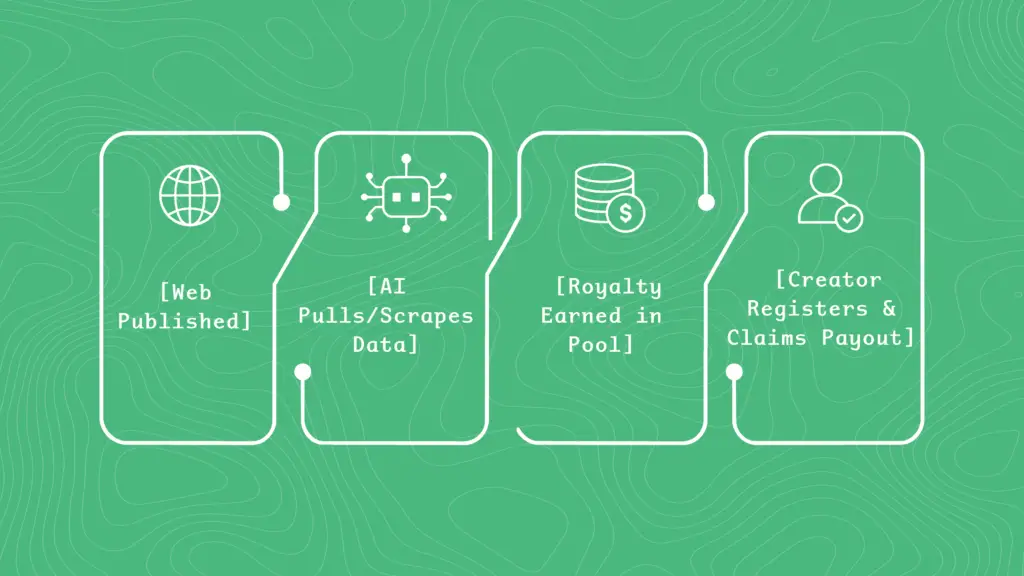
Here is how it will work:
- Free by Default: AI agents will continue to crawl and index web content freely to answer real-time queries using Retrieval-Augmented Generation (RAG).
- The Unclaimed Pool: Just as radio stations and webcasters pay into music royalty pools, AI vendors will allocate funds to “Content Monetization Pools” based on source citations and synthetic retrieval metrics.
- The Creator’s Duty to Claim: AI platforms will not chase you down to pay you. The burden will fall on content creators to register their domains, verify their IP with AI clearinghouses, and claim their micro-payouts. If you don’t claim it, your content still powers the answer—the money just sits in an unclaimed vault.
The New Frontier: Why Evolution in SEO & Web Architecture Matters Right Now
This impending shift completely changes the stakes for how content is created, found, and structured online.
In the traditional search era, Search Engine Optimization (SEO) was about getting a human to click a blue link. In the AI search era, SEO is evolving into Generative Engine Optimization (GEO). You are no longer just optimizing for human eyeballs; you are optimizing for AI engines to synthesize, cite, and credit your expertise.
If AI models cannot parse your site, identify you as a primary subject authority, or trace a piece of information directly to your domain, you become invisible—and ineligible for future monetization.
Positioning Yourself as the Sovereign Expert
To win in this upcoming system, content can no longer be generic, AI-spun noise. AI models prioritize information density, unique data, and clear attribution.
- E-E-A-T (Experience, Expertise, Authoritativeness, Trustworthiness): AI agents look for verifiable human experience. Real-world case studies, proprietary data, and distinct personal perspectives are the assets AI must cite because it cannot invent them.
- Entity Ownership: Position your brand as the source of authority on a specific topic. When an AI agent looks across the web to ground its answer, your site should be the definitive origin point.
The Architectural Shift: Designing Websites as “AI Data Nodes”
This shift fundamentally changes what a website actually is. For two decades, websites were built primarily as digital storefronts and marketing brochures for humans. Moving forward, websites will serve a dual purpose: an interactive experience for humans, and an API-ready data node for AI agents.
For web design agencies, technical strategists, and developers, this changes how we build:
- Structured Data as First-Class Citizens: Rich JSON-LD schemas, precise semantic HTML, and clear content hierarchies are no longer “extra SEO steps”—they are the core communication layer between your database and AI crawlers.
- RAG-Friendly Architecture: Web pages will be designed for quick chunking and retrieval. Instead of long, vague marketing fluff, copy will be structured into clear, authoritative, and direct knowledge blocks that Retrieval-Augmented Generation (RAG) systems can easily digest and attribute.
- Licensing & Verification Headers: Web infrastructure will soon incorporate machine-readable licensing protocols (like robots.txt extensions, C2PA provenance credentials, or Web Monetization headers). Our databases will need to store not only raw content but also the rights and digital signatures attached to it.
The Bottom Line
The web isn’t dying; it is becoming the world’s distributed knowledge graph.
The companies and creators who act now—by building deep topic authority, restructuring their websites for AI readability, and preparing their digital footprint—won’t just survive the transition from classic search. They will be the ones holding the keys (and collecting the checks) when the AI micro-royalty era has fully arrived.