Starting with your 2027 renewal, website hosting for all existing Dogwood clients will be $1,200 per year or $100 per month. Keeping a website safe takes more work than ever today, and we want to be upfront about what’s changing, why, and what you get in return.
What’s changing
If you’re on an older hosting plan that costs less than $1,200 a year, your rate will increase to $1,200 at your 2027 renewal. Nothing changes before then.
If you’re already at or above $1,200, your plan stays as it is. Some sites will continue to cost more than the standard rate due to higher traffic or storage needs, and we’ll continue to handle them individually.
Not sure which plan you’re on? Reach out, and we’ll tell you exactly where you stand and what your 2027 renewal will look like.
Why: Protecting websites takes more in the AI era
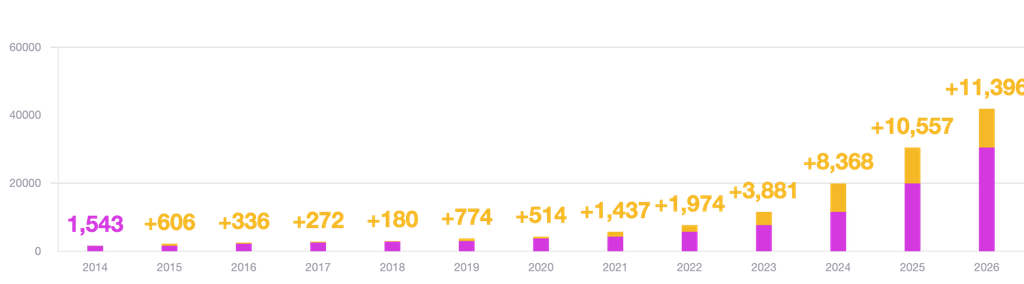
The number of known WordPress security vulnerabilities has exploded in just a few years. According to WPScan’s vulnerability statistics:
- 2021: about 1,400 new vulnerabilities were added
- 2023: nearly 3,900
- 2024: nearly 8,400
- 2025: more than 10,500
- 2026: more than 10,700 already, with two months still to go, and 1,723 added in October alone
That’s roughly seven times as many new vulnerabilities per year as in 2021. The Patchstack vulnerability database tells the same story: more than 45,000 WordPress vulnerabilities have been disclosed to date, with monthly disclosures that rarely topped 200 before 2021 now regularly exceeding 1,000.
AI is a big part of the reason. The same tools that help developers write code faster are helping attackers find weaknesses, write exploits, and launch them against thousands of sites at once. The window between a flaw being discovered and someone trying to exploit it has shrunk from weeks to hours.
A real example: PHP2Shell
In October, two critical vulnerabilities in PHP itself, the programming language WordPress runs on, became widely publicized as “PHP2Shell.” Cloudflare reported that the flaws affect all web servers running PHP 5.4 or later, and that details leaked early enough for attackers to start targeting sites before the official fix was even released.
Because the problem was in PHP rather than in a plugin, a normal WordPress update couldn’t fix it. Our team spent the entire weekend that followed patching and protecting every site we host.
Thankfully, most of our clients’ domains already run through Cloudflare, which automatically rolled out firewall protection on free plans before the vulnerabilities were officially disclosed. That bought us critical time.
If your domain or DNS isn’t on Cloudflare yet, talk to us about moving it. It’s one of the simplest, most effective layers of protection your site can have.
What we’re doing differently
The threat has changed, so the way we protect your site is changing too.
Faster updates. We’ve always kept plugins and themes up to date. Now we’re applying updates even faster, because the gap between a fix being released and attackers exploiting the old version keeps getting shorter.
Fewer plugins. Every plugin is code written by someone else, and not every developer maintains their code. Fewer plugins means fewer ways in. In 2026 alone, we’ve cut the total number of plugins across the sites we manage from nearly 600 to about 300, and we’ll keep reducing that number.
One standard platform. Every site on our server now runs on Elementor. Any new site we host will move to Elementor and use our approved plugin list. A consistent platform means we can test, update, and secure every site the same way.
Limits on adding plugins. To protect your site, we’re limiting clients’ ability to install new plugins on their own. If you need new functionality, just ask, and we’ll find a secure way to add it.
Replacing plugins that don’t measure up. If a plugin isn’t regularly maintained or doesn’t meet our standards, we’re removing it and replacing it with better code.
Adding Patchstack to every site
We’re also adding Patchstack to all of our sites. Patchstack is a security service that tracks newly discovered vulnerabilities in WordPress, plugins, and themes, and it runs one of the largest WordPress vulnerability databases in the world.
Its key feature is virtual patching. When a new vulnerability is found, Patchstack automatically adds a targeted protection rule to your site that blocks attempts to exploit it, often before the plugin’s developer has released an official fix. Think of it as a temporary shield over the weak spot until the real repair arrives.
Patchstack also gives us early warning about vulnerabilities, so we can act before they become public knowledge and attackers start looking for them.
What’s still included
Your hosting covers much more than server space, and that doesn’t change.
- Premium plugin licenses at no extra charge. We continue to cover standard plugins like Elementor Pro and Gravity Forms through our enterprise accounts.
- Elementor One credits. These power image optimization, cookie consent, email deliverability, and accessibility tools on your site.
- Daily backups are stored on our server (Google Cloud), plus a monthly backup stored off-site (Amazon), so there’s always a separate copy if something goes wrong.
- A team watching over your site. We keep your site secure and working, and if something does happen, we’re the ones who fix it. That peace of mind is what you’re really paying for.
When a site has reached the end of the road
Some websites simply get too old to protect well. Outdated code, unsupported plugins, and older builds become harder to secure every year, and for most sites that point comes somewhere past the five-year mark.
Over the coming months, we’ll be identifying sites that have reached that stage and reaching out with options. For some, that means updating the back end. For others, a complete overhaul is the better investment. Either way, we’ll walk you through it.
Questions?
We know no one likes a price increase, and we don’t take this one lightly. It reflects the real work it now takes to keep your website safe, and our commitment to doing that work well.
With this change, you’ll be able to choose whether to pay annually or switch to a monthly plan, with a credit card on file to help make this more budget-friendly.
If you’d like to know where your plan stands, talk about moving your domain to Cloudflare, or ask whether your site is due for an update, contact us. We’re here to help.